Email marketing is a direct digital channel that uses email to nurture leads, build customer relationships, and drive sales. A strong email strategy includes targeted lists, valuable content, strategic automation, and consistent optimization. When done correctly, email marketing delivers one of the highest ROIs of any channel and supports both short-term campaigns and long-term growth.
Your audience checks email every day, but most messages never earn more than a quick skim — or a swipe into the trash.
Many brands send irregular blasts, push only promotions, or rely on outdated tactics that don’t reflect how people actually interact with their inbox now. That leaves an enormous opportunity for anyone willing to treat email as a strategic, relationship-building channel, rather than an afterthought.
In this guide, you’ll learn how to start developing an email marketing strategy that aligns with your sales goals, how to structure campaigns that people actually want to open, and how to use modern tools and email marketing services to automate, measure, and scale your results.
Whether you’re a small local business or a growing brand ready to partner with an email marketing agency, you’ll find actionable steps to implement right away.
Table of contents
What is email marketing, and why does it matter?
Step-by-step email marketing setup
Real-life email campaign examples
Key benefits of email marketing
Common email marketing mistakes to avoid
Email marketing data and insights
Recommended email tools and platforms
Local angle: email for Utah and regional businesses
Take your emails to the next level with Revity Marketing
What is email marketing, and why does it matter?
Email marketing is the practice of sending targeted, permission-based messages to subscribers to inform, educate, and encourage specific actions, such as clicking, booking, or making a purchase.
It operates on owned channels — you control the list, the content, and the cadence — unlike social platforms where algorithms change overnight.
Core components include:
- A quality email list built through opt-ins and value-driven offers
- A clear plan for developing an email marketing strategy over time
- Compelling content and design tailored to your audience
- Automation sequences that respond to subscriber behavior
- Continuous testing and optimization across campaigns
Why email still delivers a strong ROI
Email remains powerful because it combines personalization, segmentation, and direct access to your audience in one place. When supported by the right email marketing services, brands can:
- Communicate directly with leads and customers without platform gatekeepers
- Nurture prospects at every stage of the funnel
- Turn one-time buyers into repeat customers and advocates
The most effective brands don’t treat email as a single campaign; they treat it as an ecosystem, built by developing an email marketing strategy that supports both immediate revenue and long-term loyalty.
Step-by-step email marketing setup
1. Define goals and role in your funnel
Start by deciding what email needs to do for your business. Do you want to capture new leads from your website or ads? Do you want to educate and warm leads before a sales call? What about driving sales and repeating purchases? Or reactivating dormant customers?
Clarifying this first makes developing an email marketing strategy much easier and ensures every message has a defined job.
2. Choose the right email platform
Select an email service provider that fits your needs. Choose from simple tools for basic newsletters and small lists; more advanced platforms for automation, segmentation, and eCommerce; and enterprise solutions, if you need deep integrations and complex logic.
If this selection feels overwhelming, working with an email marketing agency helps you shorten the learning curve and avoid costly platform switches later.
3. Build and segment your list
Strong email results start with a healthy list:
- Use opt-in forms, pop-ups, landing pages, and lead magnets
- Offer something valuable — guides, discounts, checklists, or webinars
- Segment by behavior, demographics, or lifecycle stage
Segmentation allows your email marketing services or tools to send more relevant messages, which typically leads to higher engagement and better deliverability.
4. Plan your email strategy and calendar
Now move from random sending to developing an email marketing strategy with structure.
First, decide your core content pillars (education, promotions, brand stories, or case studies). Then, map out a simple monthly or quarterly calendar. Finally, align emails with launches, seasons, or live campaigns.
This calendar becomes the backbone of your ongoing email marketing services, whether you handle them in-house or partner with an email marketing agency.
5. Create high-performing email content
Every email should answer three questions quickly: Who is this for? Why should they care? What should they do next?
Focus on subject lines that promise clear value or curiosity. Avoid clickbait in your titles.
Large blocks of text are overwhelming, so it’s best to break up your email into short, scannable sections.
So many people view emails on their smartphones; you’ll want a mobile-friendly design with buttons and CTAs that readers simply tap.
Finally, you’ll want to include one primary CTA per email whenever possible.
When developing an email marketing strategy, also define a tone and visual style that matches your brand across all channels.
6. Set up automation workflows
Automation enables you to deliver the right message at the right time, eliminating the need for manual email sending. Useful flows include:
- Welcome series for new subscribers
- Lead nurture sequences for high-intent prospects
- Abandoned cart flows for eCommerce
- Post-purchase follow-ups and review requests
- Re-engagement campaigns for inactive subscribers
Many email marketing services include pre-built automation templates; an experienced email marketing agency customizes these templates to fit your specific customer journey.
7. Test, measure, and improve
Track key metrics regularly to identify what’s working and where to make improvements. Focus first on open rates and click-through rates to understand how compelling your subject lines and in-email content are.
Then, monitor unsubscribe rates and spam complaints to catch signals that you might be sending too frequently, targeting the wrong segment, or missing the mark in terms of relevance.
Finally, keep a close eye on conversion rates for key actions, such as purchases, bookings, or downloads, as these metrics directly connect your email performance to revenue and results.
From there, run simple, focused tests. Start with A/B tests on subject lines to determine which tone, length, or structure yields the most opens. Experiment with different send times and days to identify when your audience is most responsive. Try variations of calls to action and email layouts to determine which versions drive the most clicks and conversions.
Testing is not a one-time task — it’s an ongoing part of developing an email marketing strategy that stays effective as your list, offers, and audience behavior evolve.
Real-life email campaign examples
Lead nurture example
A B2B company uses a five-part educational series after someone downloads a guide. Each email addresses a specific problem, provides a practical tip, and gently encourages the reader to schedule a consultation. Over time, this sequence moves leads from cold to sales-ready without a hard sell in every message.
E-commerce example
An online retailer sets up an abandoned cart series, which includes a reminder, a social proof email with reviews, and a final message offering an incentive. Many email marketing services offer these automated emails as a standard deliverable, and they recover sales that would otherwise be lost.
Local service business example
A local service provider sends a monthly “tips and seasonal reminders” newsletter, plus quarterly promotions. This positions them as a helpful authority while giving subscribers occasional, timely reasons to book again — exactly the kind of system an email marketing agency can design around local demand cycles.
Key benefits of email marketing
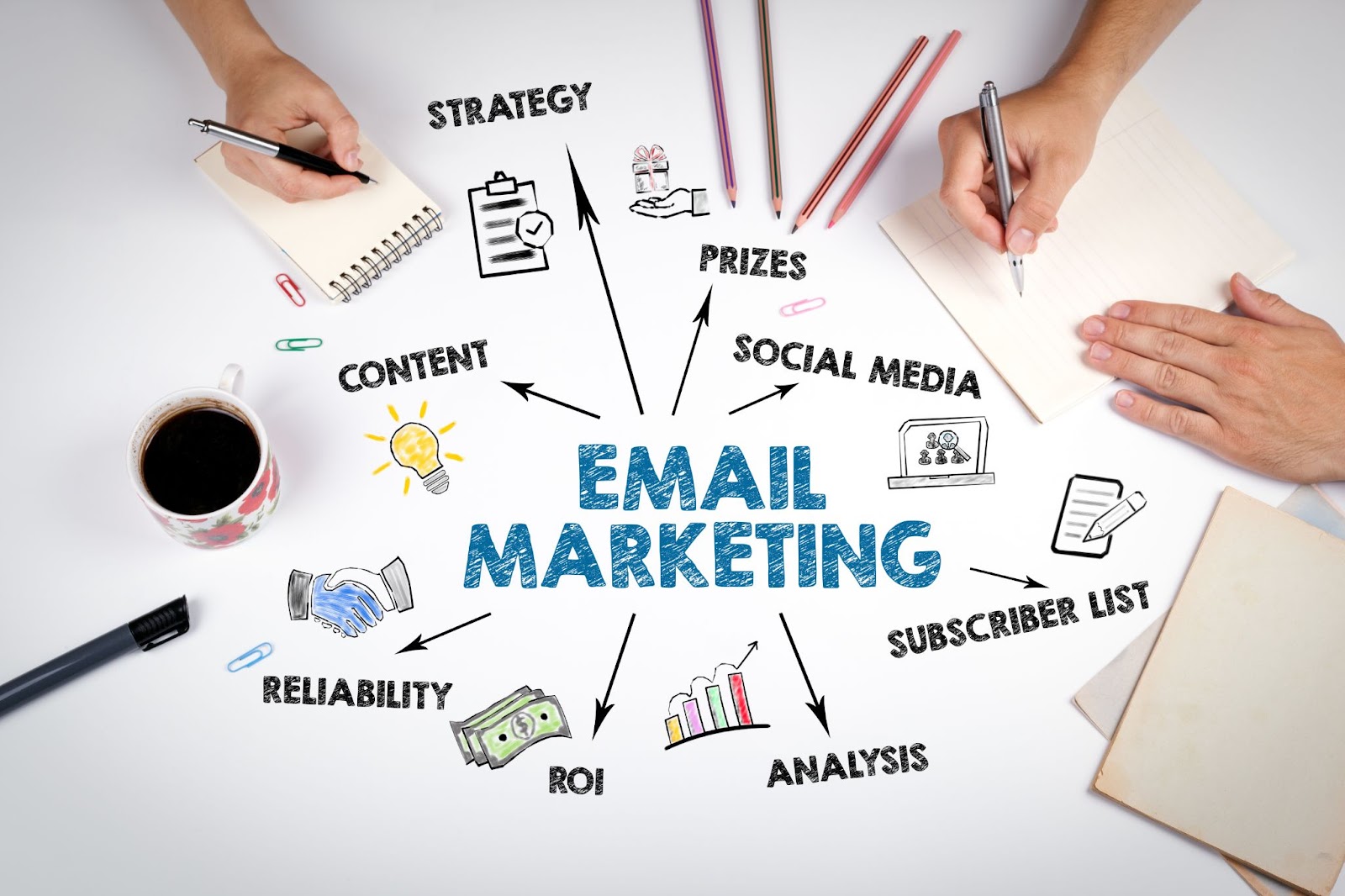
- High ROI: Low cost per send with strong potential for revenue per campaign.
- Ownership: You control the list and messaging, independent of algorithm changes.
- Personalization: Tailor content to behavior, interests, and lifecycle stage.
- Scalability: Automation enables you to reach hundreds or thousands with minimal additional effort.
- Retention: Keeps your brand visible between purchases, strengthening loyalty.
For many brands, investing in structured email marketing services becomes a key pillar of sustainable, long-term growth.
Common email marketing mistakes to avoid
Even strong brands stumble with email. Watch out for these mistakes:
- No clear strategy: Sending sporadic blasts without first developing an email marketing strategy.
- Over-promotion: Only sending discounts and sales with no educational or value-based content.
- Poor mobile experience: Hard-to-tap links, tiny text, or layouts that break on phones.
- Ignoring segmentation: Treating every subscriber the same regardless of interests or behavior.
- Neglecting data: Not reviewing performance, testing, or making iterative improvements.
An email marketing agency or a structured internal process helps catch and correct these issues quickly.
Email marketing data and insights
Without citing specific numbers, several patterns show up consistently across many industries:
- Personalized and segmented campaigns tend to outperform generic blasts.
- Automated flows (like welcome series and abandoned cart emails) usually generate disproportionately high revenue compared to their send volume.
- Regular, predictable sending — paired with valuable content — generally improves engagement and deliverability over time.
These trends are important inputs when developing an email marketing strategy that is both effective and sustainable.
Recommended email tools and platforms
While specific tools change over time, most brands benefit from a stack that covers:
- Email platform (ESP): For sending campaigns and building automation
- Lead capture tools: Forms, pop-ups, and landing page builders to grow your list
- Design tools: To create branded templates and on-brand graphics
- Analytics and testing tools: To understand behavior and run A/B tests
- CRM and e-commerce integrations: To sync customer data and purchase history
Many email marketing services bundles include these pieces; if you work with an email marketing agency, they will typically recommend and implement a stack that fits your size and goals.
Email marketing FAQs
Q: How often should I send marketing emails?
A: Most brands find success sending at least one email per month, and many do well with weekly campaigns. The right frequency depends on your audience, content quality, and available resources, so plan to test the cadence as part of developing an effective email marketing strategy.
Q: What makes a “good” open and click rate?
A: Benchmarks vary widely by industry and the quality of the list. Rather than chasing generic numbers, track your own performance over time and aim for steady improvement through better targeting, subject lines, and content.
Q: How can I ethically grow my email list?
A: Use clear opt-in forms, valuable lead magnets, and transparent expectations. Avoid buying lists or adding people without consent. Quality, engaged subscribers are far more valuable than a large but uninterested audience.
Q: What is email automation, and why is it important?
A: Automation sends emails based on behavior or timing — such as sign-ups, purchases, or inactivity — without manual effort each time. It enables your email marketing services to operate around the clock, delivering relevant messages exactly when subscribers need them.
Q: How can I prevent emails from being sent to the spam folder?
A: Maintain a clean, permission-based list, avoid spammy language, send content your audience actually wants, and authenticate your domain properly. Consistent engagement is one of the best signals that inbox providers look for.
Q: How do I know if my email marketing efforts are effective?
A: You’ll know your email marketing is working when engagement and business results both trend in the right direction. Look for healthy open and click-through rates, stable or declining unsubscribe rates, and a clear link between your campaigns and key actions, such as purchases, bookings, or demo requests.
Over time, you should see email contributing a reliable share of your revenue or lead volume, not only occasional spikes from one-off promotions.
Q: What should I send to my email list besides promotions?
A: If every email is a discount, subscribers learn to only pay attention when you’re running a sale. Mix in value-driven content that helps, educates, or inspires your audience. This could include how-to guides, FAQs, case studies, behind-the-scenes stories, user-generated content, or curated resources.
When people feel your emails are consistently useful, they’re more likely to stay subscribed, engage often, and respond when you do send a strong offer.
Q: How important is list cleaning, and how often should I do it?
A: List cleaning is critical for maintaining deliverability and accurate performance data. Inactive subscribers — people who haven’t opened or clicked in months — drag down your metrics and send negative signals to inbox providers.
Plan to run a re-engagement campaign a few times a year, then remove or suppress subscribers who still don’t respond. This keeps your list healthier, improves engagement rates, and helps your email marketing strategy stay effective over the long term.
Q: Should I personalize emails, and what does that really mean?
A: Personalization is much more than inserting a first name in the subject line. Effective personalization tailors content to what people have shown you they care about — through their behavior, past purchases, or expressed interests.
This might involve sending different product recommendations, content topics, or offers to distinct segments. When done thoughtfully, personalization makes emails feel more relevant and increases the likelihood that subscribers will open, click, and convert.
Q: Is it better to send plain-text or designed HTML emails?
A: Both formats work well; the best choice depends on your brand and goals. Designed HTML emails are ideal for showcasing products, telling visual stories, and making strong calls to action.
Simpler, text-leaning emails feel more personal and “from a human,” which is effective for service-based businesses or relationship-focused campaigns. Many brands use a mix of clean, lightly branded templates that read like a conversation but still include clear buttons and structure.
Q: What’s the best way to welcome new subscribers?
A: A structured welcome sequence is one of the most valuable pieces of your email marketing. Instead of sending a single confirmation or discount code, plan a short series that introduces your brand, sets expectations, delivers your promised resource or offer, and highlights your best content or products.
This is your chance to make a strong first impression, show new subscribers what you stand for, and guide them toward their next step with you.
Q: How long should my marketing emails be?
A: There’s no universal “perfect” length, but clarity beats length every time. Promotional or announcement emails are often concise, focusing on one main message and a clear call to action.
Educational newsletters and thought-leadership emails may be longer, as long as they’re well structured and easy to skim. A good rule of thumb is to write enough to communicate value and motivate the next click — then stop, instead of cramming multiple competing messages into one send.
Q: Can small businesses really compete with big brands in the inbox?
A: Yes. In many cases, small businesses have an edge because they are more personal, nimble, and specific with their messaging. You don’t need a massive team to send relevant, well-timed emails; you need a clear understanding of your audience and a simple, consistent plan.
By focusing on helpful content, authentic voice, and a few core automations, smaller brands build strong relationships that big, generic campaigns often struggle to match.
Local angle: email for Utah and regional businesses
For regional and local businesses, email bridges the gap between online visibility and in-person or service-based sales. You can:
- Promote seasonal offers tied to local weather, events, or holidays
- Share community involvement, sponsorships, and local success stories
- Use email to stay top-of-mind between visits or bookings
If your audience concentrates in specific cities or regions, an email marketing agency familiar with your market will tailor messaging and timing to match local habits and expectations.
Take your emails to the next level with Revity Marketing
Email marketing shouldn’t feel like guesswork or another task you push to the bottom of your to-do list. It should be a reliable engine that nurtures your audience, drives repeat sales, and supports every other channel you’re investing in.
Revity Marketing helps you turn that vision into reality by combining strategy, copy, design, and automation into one cohesive email ecosystem tailored to your business.
Whether you need help developing an email marketing strategy from scratch, refreshing underperforming campaigns, or building advanced automations that work around the clock, Revity’s team can step in at any stage. You get clear planning, transparent reporting, and a partner focused on real outcomes — not vanity metrics.
If you’re ready to turn your list into one of your highest-performing assets, reach out to Revity Marketing today. Let’s build an email program that your subscribers look forward to — and that your bottom line feels every time you hit send.